

TLDR:
The agentic AI replacement narrative that justified 18 months of tech layoffs is cracking. Token prices are going UP across all three frontier labs. Microsoft just canceled Claude Code internally because the bill was too high. GitHub is killing flat-rate pricing in June. Uber blew its entire 2026 AI budget by April. 95% of enterprise AI pilots are still failing despite spending going up 65%. The data center buildout looks exactly like the 1999 fiber bubble.
This isn’t a case against agentic AI as a category. The deployments that work, augmentation with humans in the loop, scoped to specific workflows, are quietly delivering real ROI. The category that’s breaking is the full-replacement fantasy.
Meanwhile, the companies running the working playbook are hiring hard. Amazon: 11,000 engineers. Salesforce: 1,000 new grads. IBM is tripling entry-level hiring. ClickUp just announced $1M salary bands for AI-native operators. Gartner forecasts 50% of AI-attributed layoffs will be quietly reversed by 2027. Forrester says the same. But the rehire is selective, and the new roles pay less unless you can wield agents.
This is the rehire wave nobody is pricing in. It started in April. It is likely to accelerate over the next 18 months. After that, the cohort closes, and a new equilibrium sets in for the next decade of knowledge work.
Here’s the full case.
Meta laid off 8,000 people on Wednesday. The stock barely moved.
Two months ago, Block laid off 4,000, and the stock jumped 20% after hours. Same playbook. Same AI narrative. Same press release language. Completely different market reaction.
Something broke in between. Let me show you why.
The pump is dead
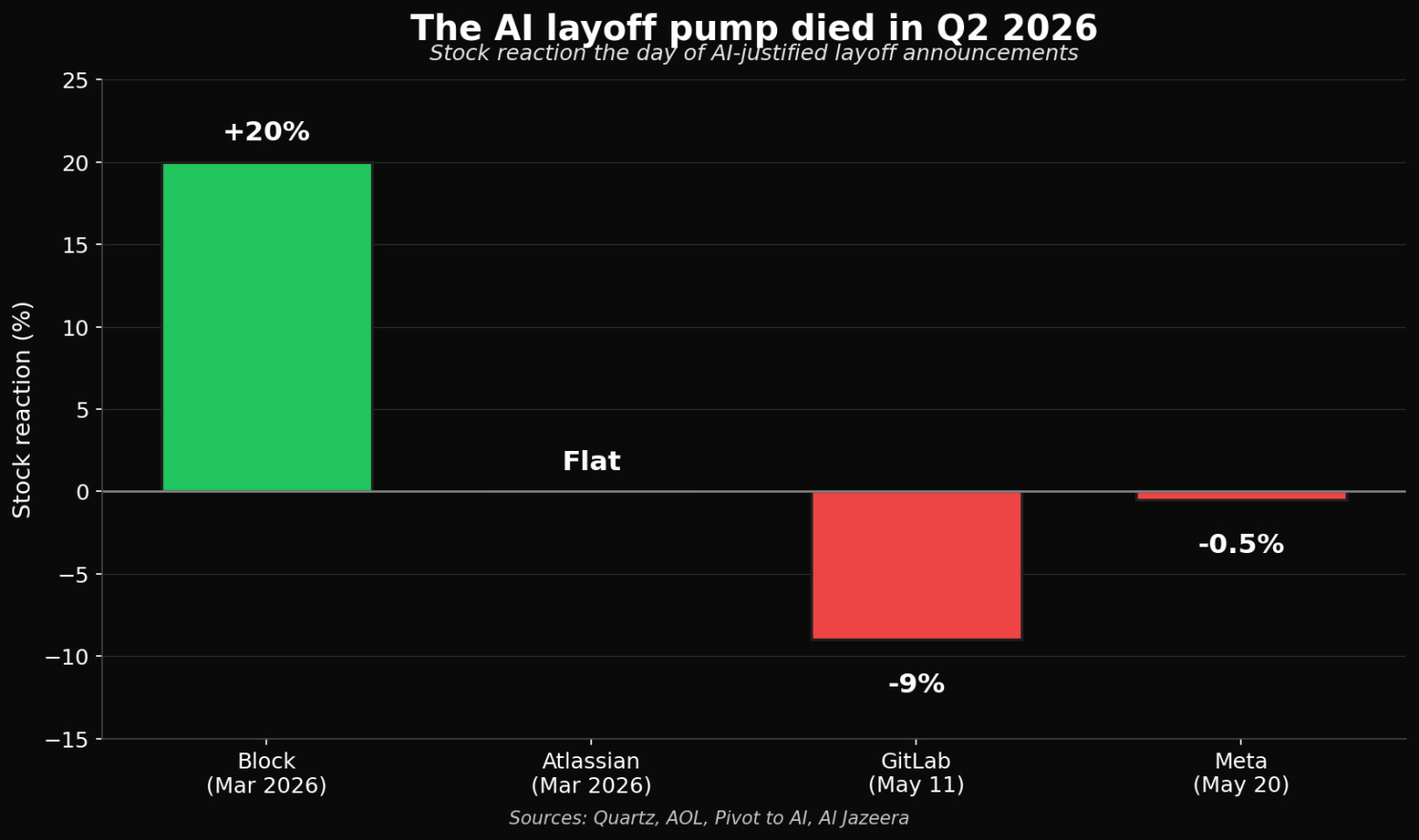
The AI layoff stock pump worked for 18 months, and then it died sometime in Q2 2026. Wall Street stopped rewarding the playbook, which means CEOs just lost their main reason to keep cutting. The timeline tells the story better than any analysis can.
Block, March 2026. Jack Dorsey announced 4,000 layoffs, 40% of the company, and framed the entire cut as a pivot to AI. The stock jumped 20% after hours, rose another 17% during Friday morning trading, and the framing seemed to be working perfectly. Classic pump.
But the cracks were already visible if you knew where to look. When Wired pressed Dorsey directly on whether this was AI washing, he gave a wishy-washy answer that satisfied nobody. Then, in a follow-up post on X, he quietly admitted the real reason: “over-hired during covid because I incorrectly built 2 separate company structures (Square & Cash App) rather than 1, which we corrected mid 2024.” Aaron Zamost, Block’s head of communications from 2015 to 2020, went further and wrote a New York Times op-ed calling the cuts to the policy team and DEI roles “standard prioritization and cost management, not an A.I.-driven reinvention.”
The market didn’t care in March. By May, it absolutely did.
GitLab, May 11. CEO Bill Staples announced layoffs and an “agentic era” restructuring using almost the same script as Block. The stock dropped 9% the next day and closed at $23.08, down from $52 a year ago, leaving the company worth less than a third of its 2021 peak. Wall Street wasn’t buying the agentic era pitch any more than it was buying the broader narrative.
Meta, May 20. Mark Zuckerberg cut 8,000 people, 10% of the workforce, in a move that would have moved the stock 5% in either direction a year ago. The stock stayed flat in midday trading. Meta is now down 8.7% year to date, while Alphabet is up 24% and Amazon is up 12%, and Senator Bernie Sanders publicly criticized the cuts within hours of the announcement.
Sam Altman, of all people, has been the loudest voice calling this AI washing. His framing is that companies are using AI as a rationale for layoffs they were going to make anyway, regardless of any actual productivity story. The market took longer than I expected to catch on to the pattern, but once it did, the trick stopped working almost overnight.
The pump worked for as long as it did because the AI narrative gave CFOs perfect moral cover for cost-cutting. Boards rewarded the framing because the margin expansion story was easy to model and even easier to communicate to investors. Four quarters later, the margin expansion never showed up in earnings, and once GitLab dropped 9% on an “agentic era” announcement, every other CEO got the memo. The trick is done.
This matters because layoffs aren’t free. They cost severance, morale damage, customer trust, knowledge loss, and the recruitment expense of rehiring later when you realize you cut too deep. CEOs were willing to absorb all of those costs as long as the stock pumped on the announcement, but without the pump, the math simply doesn’t work anymore.
The token economics are broken
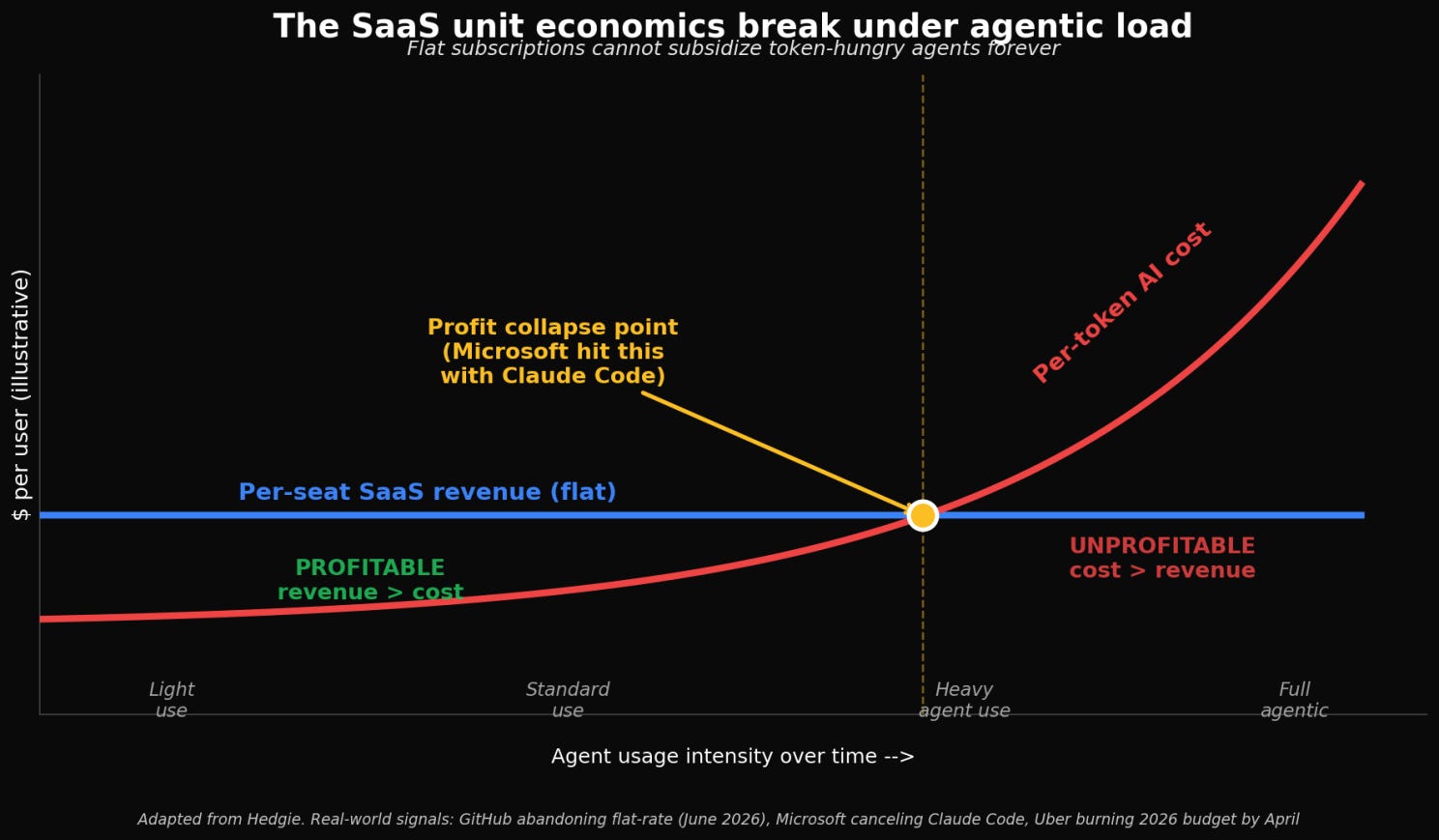
The pitch was simple -> Tokens get cheaper -> Agents replace humans -> Margins expand.
Reality flipped on all three, and the bills coming due are big enough that even Microsoft just blinked.
Frontier model prices are going up, not down.
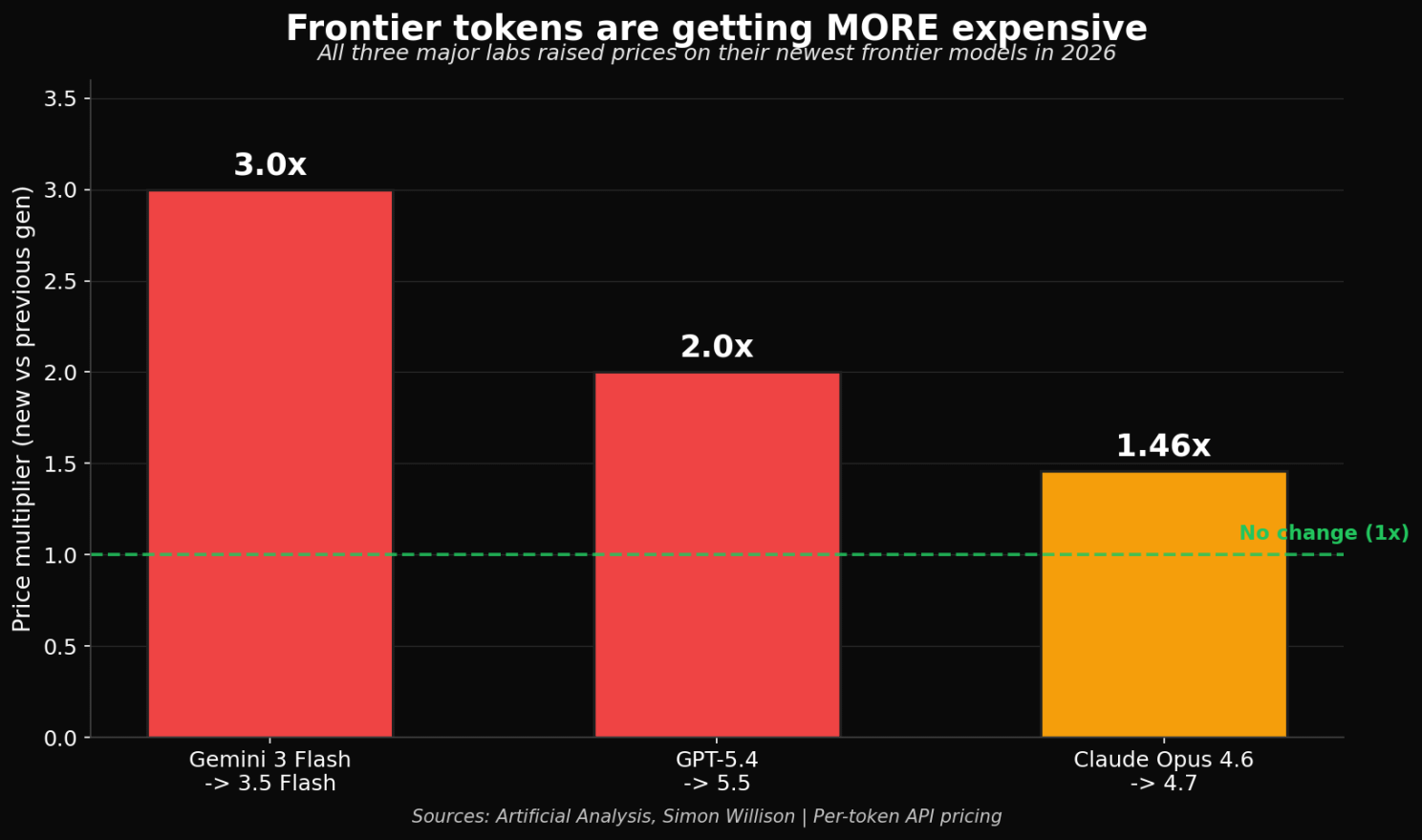
Gemini 3.5 Flash launched on May 19 at $1.50 input and $9 output per million tokens, which is 3x the price of Gemini 3 Flash. Artificial Analysis ran the full Intelligence Index benchmark and found the new Flash was 5x more expensive to run than the previous Flash, and 75% more expensive than Gemini 3.1 Pro. That’s for a “Flash” tier model, the one specifically positioned as the cheap workhorse for high-volume agentic workloads.
The same pattern shows up across the labs. GPT-5.5 launched at 2x the price of GPT-5.4. Claude Opus 4.7 is 1.46x the price of Opus 4.6 once you account for the new tokenizer. Simon Willison summed up the trend perfectly in his post on the Gemini 3.5 launch: “All three of the major AI labs are starting to probe the price tolerance of their API customers.” This is the exact opposite of the pricing trajectory the layoffs were sold on.
The AI Tax is real, and CFOs are now tracking it.
Procurement intelligence firm Tropic published data showing AI-driven software prices have jumped 20% to 37% across vendor categories on enterprise renewals, with vendors restructuring their SKUs to force migrations into more expensive AI-bundled plans. They call it the “AI tax,” and even buyers who negotiate hard still see final pricing land 12% above pre-AI baselines.
Fortune ran a piece on April 28 quoting Nvidia exec Pat Lee directly: “the cost of compute is far beyond the costs of the employees.” That’s the maker of the GPUs telling enterprise buyers that AI is currently more expensive than the humans it was supposed to replace, which should give you a sense of how upside-down the unit economics have become.
Anthropic got caught nerfing.
On April 23, Anthropic published a public postmortem confirming what developers had been complaining about for six weeks. Claude Code, Claude Agent SDK, and Claude Cowork had all been degraded between March 4 and April 20 due to three separate product changes. Two of the three changes were deliberate decisions rather than bugs, specifically a reasoning effort downgrade and a verbosity cap on the system prompt.
Worth saying clearly: this wasn’t model regression at the weights level. The underlying model was fine. Anthropic ran the math, decided to reduce output quality to manage inference costs, and got caught when developers started filing GitHub issues comparing outputs side by side. They eventually issued the postmortem and reset usage limits, though the phantom-token bug from the same incident was still present in v2.1.137 as of May 13.
I’m not telling you this to bash Anthropic. I’m telling you this because it reveals that the supply side is more constrained than the marketing suggests. If frontier labs are willing to nerf their flagship products to manage demand, the “infinite cheap intelligence” thesis is fiction.
GitHub just killed flat-rate pricing.
On April 27, GitHub announced that Copilot is moving to usage-based billing effective June 1, 2026. Premium request units are gone, replaced with GitHub AI Credits priced by token consumption. The base subscription prices stay the same, but the value you get inside those prices drops sharply for anyone doing agentic work.
GitHub Chief Product Officer Mario Rodriguez justified the shift as essential for a “sustainable business model,” which is corporate-speak for the fact that the flat-rate experiment was bleeding money on heavy agentic users. This is the canary in the coal mine that everyone building on top of LLMs should be paying attention to. GitHub is owned by Microsoft and runs on Azure with effectively unlimited compute, and if GitHub can’t sustain flat-rate AI pricing under those conditions, nobody can. Every other developer tool is going to follow within 12 months.
One developer in the GitHub community thread did the math on his actual workflow and posted the result. He was paying €39.99/month for Pro+ in 2025 with 1,500 premium requests. Under the new model, his projected cost goes from €67 in April to €966 in June. That’s a 14x increase for the same usage pattern, and that’s the bill enterprise CFOs are about to be staring at across every developer in their org.
Uber blew the entire 2026 AI budget by April.
CTO Praveen Neppalli Naga revealed on April 15 that Uber had exhausted its full-year AI budget just four months in. The company’s R&D budget is $3.4 billion. They rolled out Claude Code to 5,000 engineers in December 2025, usage nearly doubled by February, and heavy users were costing up to $2,000 per person per month. The direct quote from the CTO is the one I keep coming back to: “I’m back to the drawing board, because the budget I thought I would need is blown away already.”
Now scale this up. Uber is one company with a $3.4B R&D budget. If they can’t sustain 5,000 engineers on Claude Code for a full year, what does that say about every other Fortune 500 trying to pivot to agents? Pegasystems already put a token usage calculator on their homepage, token budgeting is now standard enterprise procurement, and CFOs across the industry are reviewing line items called “Anthropic credits” for the first time in their careers.
Microsoft pulled the plug on Claude Code internally.
This is the data point that should make every CFO in tech sit up and pay attention.
The Verge reported on May 14 that Microsoft is canceling thousands of internal Claude Code licenses across its Experiences and Devices division, which covers Windows, Microsoft 365, Outlook, Teams, and Surface. The deadline is June 30, 2026, and engineers are being moved to GitHub Copilot CLI. The official framing is “tool consolidation,” but the underlying reality is more revealing than that framing suggests.
Microsoft invited Claude Code in last December. Thousands of developers picked it up over the following six months, and sources told The Verge that it became “very popular” inside the company. Then the company that put $13 billion into OpenAI and runs the Azure infrastructure powering most of Anthropic’s compute looked at the bill, looked at the cannibalization of their own Copilot product, and decided it wasn’t worth paying.
That is the single most important data point in this entire essay, and not because Microsoft is special. The point is that if Microsoft can’t justify the bill even with effectively infinite cloud capacity and a fiscal partnership at the model layer, nobody else in tech can either.
Personal data point worth adding here. I’m on an Anthropic Enterprise plan, and I burned 80% of my monthly credits in half a month doing genuinely productive work. The math that the layoffs were predicated on assumed I’d cost a fraction of a junior developer. The reality is that I’m spending agent budget that already exceeds the salary of a new grad in Bangalore, and I’m one person.
The CXO economics simply don’t work the way they were sold. Tokens are not the cheap labor substitute that the full-replacement narrative promised, at least not at the frontier tier where autonomous replacement work has to happen. Augmentation economics are different and they’re working.
The data center bubble
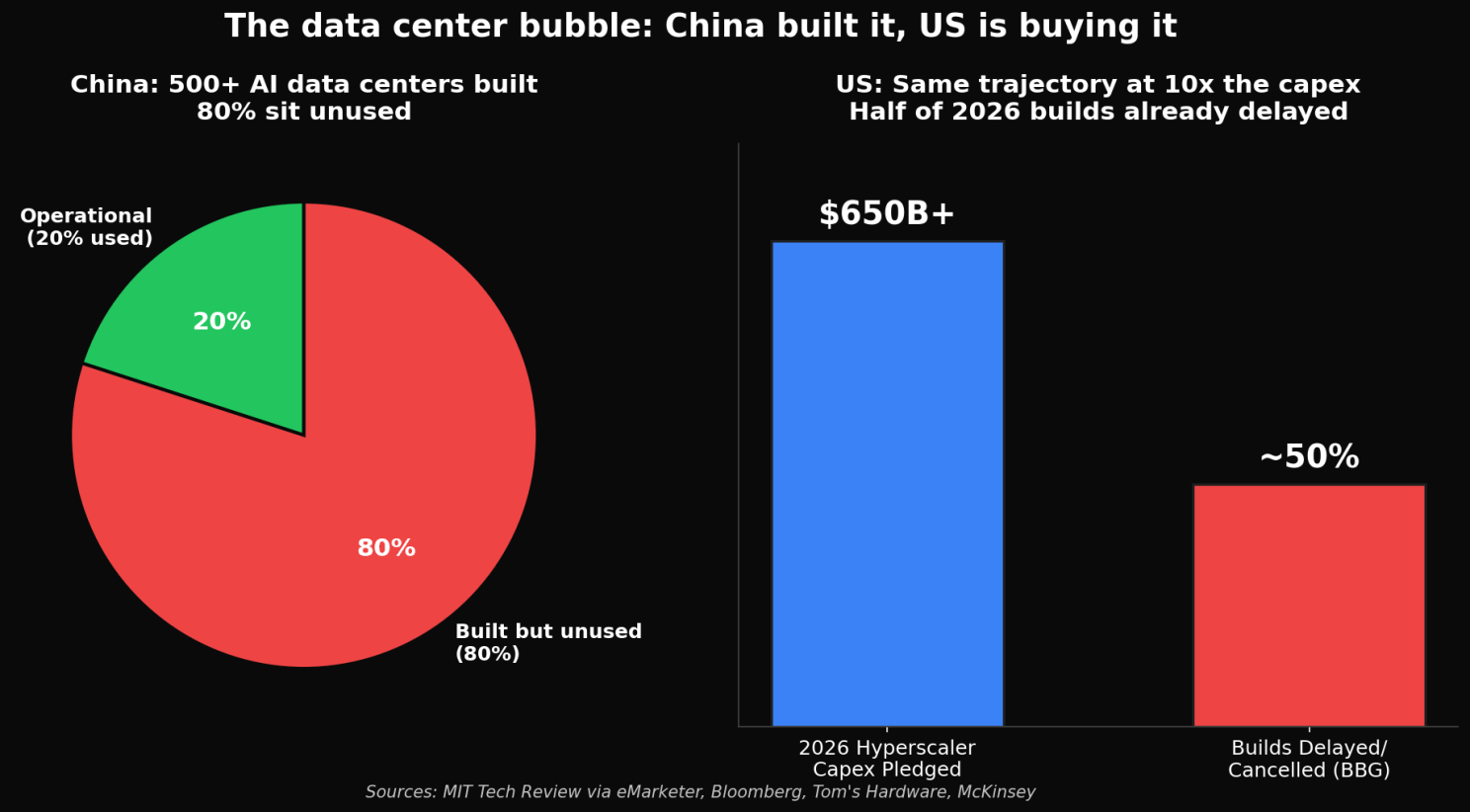
China built 500+ AI data centers in 2023 and 2024. Up to 80% sit unused.
The United States is on the same trajectory at 5x to 10x the capex.
This is the part of the story that doesn’t get enough airtime. Even if the agentic thesis were correct on the demand side, the physical supply layer is over-committed in ways that look exactly like every prior infrastructure bubble.
The China precedent. Local governments, state-backed firms, and real estate speculators launched over 500 AI data centers in 2023 and 2024. 150+ are operational. But reports indicate up to 80% of the newly built compute resources remain unused, per MIT Technology Review. Most were built in remote areas for cheap power, too far from AI hubs where low-latency inference actually matters. The driver was political incentives and hype. The outcome is empty buildings.
The US version is bigger. Alphabet, Amazon, Meta, and Microsoft are expected to spend more than $650 billion combined in 2026 alone on AI capacity expansion. McKinsey projects $7 trillion in global data center construction through 2030. The WTO reports that imports account for 70-90% of the value of US AI investment. That’s a level of import intensity with few parallels in modern American industrial history. And the supply chain runs through China for transformers, switchgear, and batteries.
Half of the planned US builds for 2026 are already delayed or canceled per Bloomberg. TD Cowen reported that Microsoft has already cancelled leases with at least two data center operators, totaling a few hundred megawatts.
The bubble warning came from inside the house. Alibaba Chairman Joe Tsai, who has every incentive to talk his own AI book up, instead publicly called the US data center spend a bubble at the HSBC Hong Kong summit. His exact frame: “I’m still astounded by the type of numbers that’s being thrown around in the U.S. about investing into AI. People are talking, literally talking about $500 billion, several hundred billion dollars. I don’t think that’s entirely necessary.”
His specific red flag was developers building “on spec” without binding agreements from the big AI buyers. Same pattern that broke China’s buildout.
The grid is the hard ceiling. Morgan Stanley forecasts that US data centers face a 44 gigawatt electricity shortfall in the next three years. China added 543 GW of power capacity in 2024 alone, more than the total power capacity the US has added in its entire history. Goldman Sachs: “AI’s insatiable power demand is outpacing the grid’s decade-long development cycles, creating a critical bottleneck.”
This is the structural problem. Token prices stay high because the supply layer can’t scale. The supply layer can’t scale because you can’t recommission a nuclear reactor in 18 months, and you can’t build a gigawatt solar farm in two years. Stifel Nicolaus is already forecasting an S&P 500 correction tied to this dynamic. They describe the data center capex boom as “a one-off build-out of infrastructure, while consumer spending is clearly on the wane.”
The demand side is constrained by token economics. The supply side is constrained by capex risk and grid physics. If either of these cracks, the entire full-replacement thesis cracks with it. If both crack, the layoffs reverse faster than anyone is pricing in.
The ROI math isn’t there
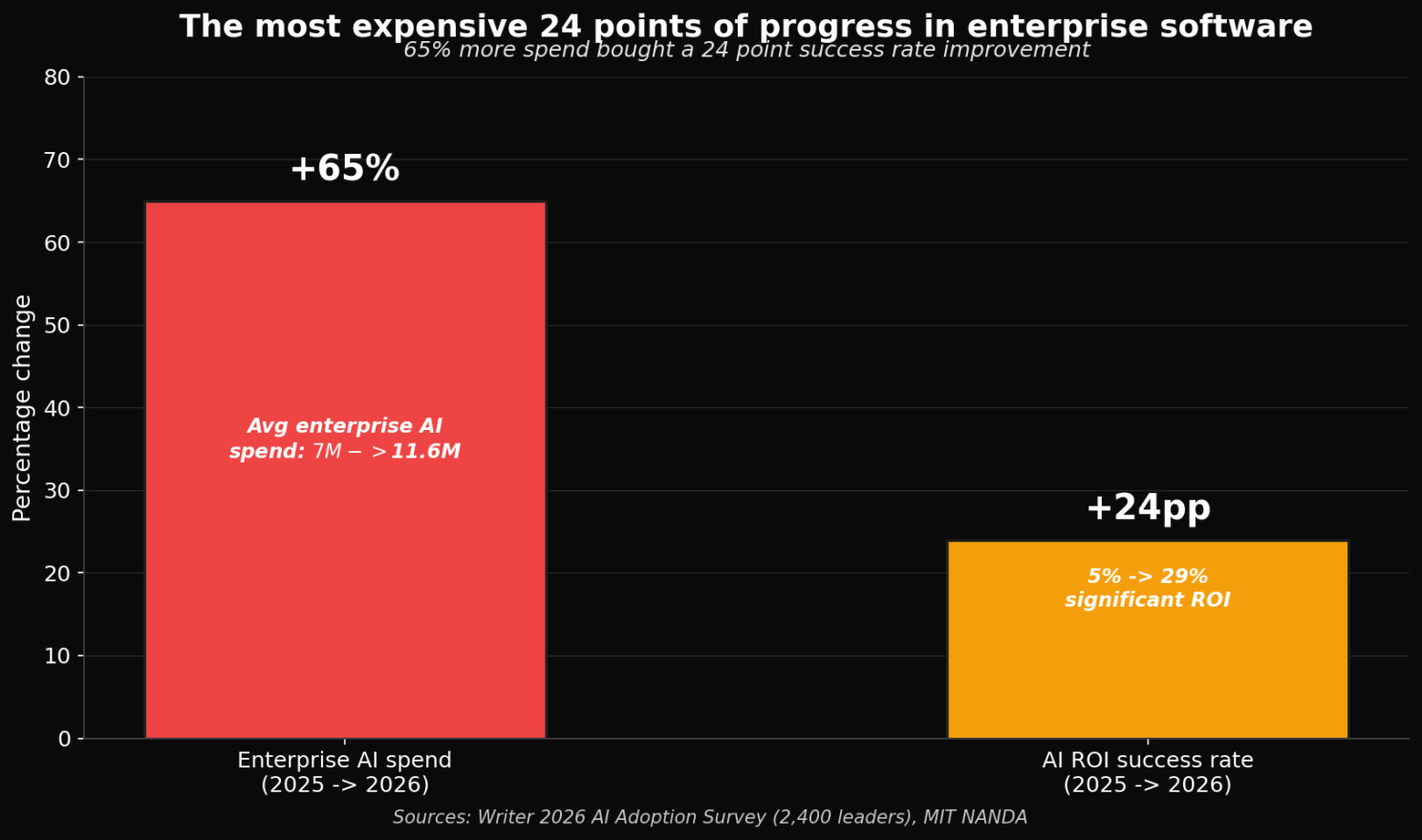
Companies spent 65% more on AI in 2026 than in 2025. Average enterprise AI spend went from $7 million to $11.6 million. The success rate moved from 5% to 29%, which sounds like progress until you do the arithmetic and realize that’s the most expensive 24 points of progress in enterprise software history. And the curve is flattening fast.
The data comes from Writer’s 2026 AI Adoption in the Enterprise survey, released April 7, covering 2,400 leaders, including 1,200 C-suite executives. The numbers are brutal across every dimension. 97% of executives deployed AI agents in the past year, but only 29% report significant ROI from generative AI, and only 23% see significant returns from agents specifically. 48% describe AI adoption at their company as a “massive disappointment,” 75% admit their AI strategy is “more for show” than actual guidance, and 38% of CEOs report high or crippling stress around AI strategy. 64% fear losing their job if they fail to lead the transition.
The abandonment curve is even worse than the ROI numbers suggest. 42% of companies abandoned most AI initiatives in 2025, up from 17% the year before, which is a 147% year-over-year increase. The average organization scrapped 46% of POCs before they ever hit production, which means roughly half of all AI experiments inside the enterprise are dying before they ever generate revenue.
Independent corroboration is now stacked deep across multiple research firms. RAND Corporation found that AI projects fail at twice the rate of non-AI IT projects. Carnegie Mellon’s TheAgentCompany benchmark showed that the best AI agents fail nearly 70% of real-world office tasks. Gartner projects 40% of agentic AI projects will be cancelled by 2027 due to governance failures. The pattern is consistent regardless of who is measuring or how.
Now look at where the 5-29% who actually succeed are winning. Back-office automation, specialized vendor tools, tightly scoped use cases. Not flashy chatbots, not agentic replacement of knowledge workers. The MIT NANDA research found that purchased AI solutions succeed 67% of the time versus 22% for internal builds, which is a brutal indictment of every company that tried to build agentic platforms in-house instead of buying focused tools from specialized vendors.
The pattern across the winners is consistent: scoped use cases, humans reviewing the output, agents automating the repeatable middle of the pipeline. As a solution consultant at Adobe I’ve watched this play out across enterprise deployments in APAC, and Forrester’s Total Economic Impact studies show the same shape: triple-digit ROI when the deployment is scoped right, near-zero when companies try to remove humans from the workflow entirely.
The companies that bet hard on full agentic replacement of human workers are sitting in the 71% that already abandoned the initiative or are about to. The companies that succeed are doing humans plus agents, not agents alone. This is the entire upskilling thesis in one paragraph.
The rehire wave
The companies that fired the loudest in 2025 are quietly hiring in 2026. Watch what they do, not what they say.
The headline data point comes from Gartner. Published February 3, 2026. Direct forecast: by 2027, 50% of companies that attributed headcount reductions to AI will rehire staff to perform similar functions, but under different job titles. Forrester reached the same conclusion in their late 2025 future of work outlook with one critical addendum: “We expect half of AI-attributed layoffs to be quietly reversed, with jobs returning offshore or at lower wages.”
That second part matters. The rehire is real. But the new roles pay less unless you’re in the cohort that can actually wield agents. Which is exactly the labor market split this essay is about.
55% of employers already regret their AI-driven layoffs per HR Director coverage. The macro data is even more striking. Citadel Securities just published Indeed posting data showing software engineering postings crashed from 73 in January 2024 to 61 by mid-2025, then ripped vertical to over 70 by early 2026. Software engineering is leading the broader labor recovery, which is the exact opposite of what the AI-replacement narrative would predict. The BLS independently projects 15% software developer growth from 2024 to 2034, against 3% for all occupations.
The economic logic is Jevons paradox. When a resource becomes cheaper or more efficient to produce, total demand for it goes up, not down. The 19th-century example is coal: when steam engines got more efficient, coal consumption exploded rather than collapsed. Software is now playing out the same way. AI didn’t replace engineers; it expanded the surface area of what’s worth building. The companies that internalized this fast are the ones currently hiring.
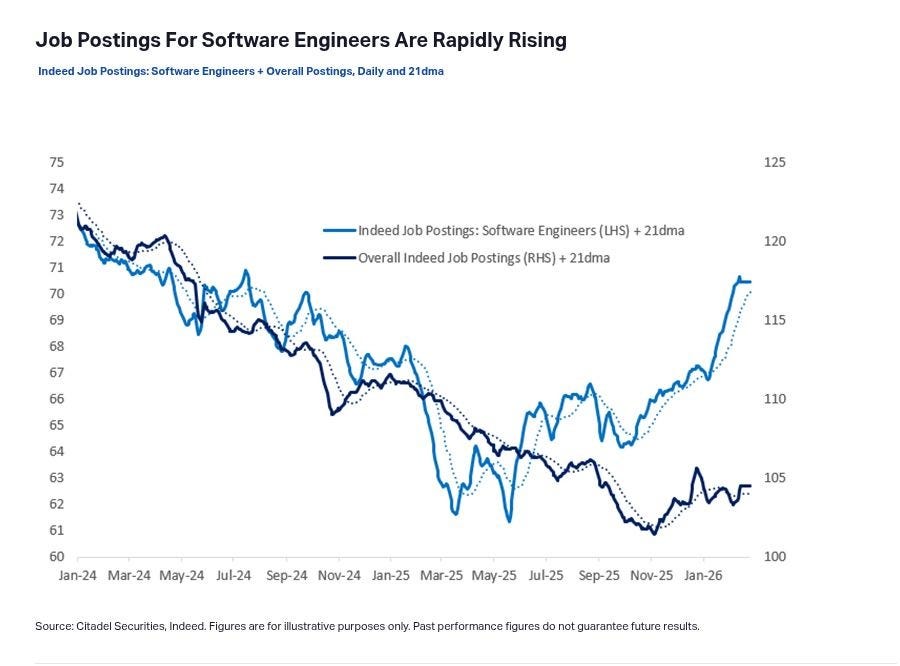
The macro recovery is real. The company-level data points back it up.
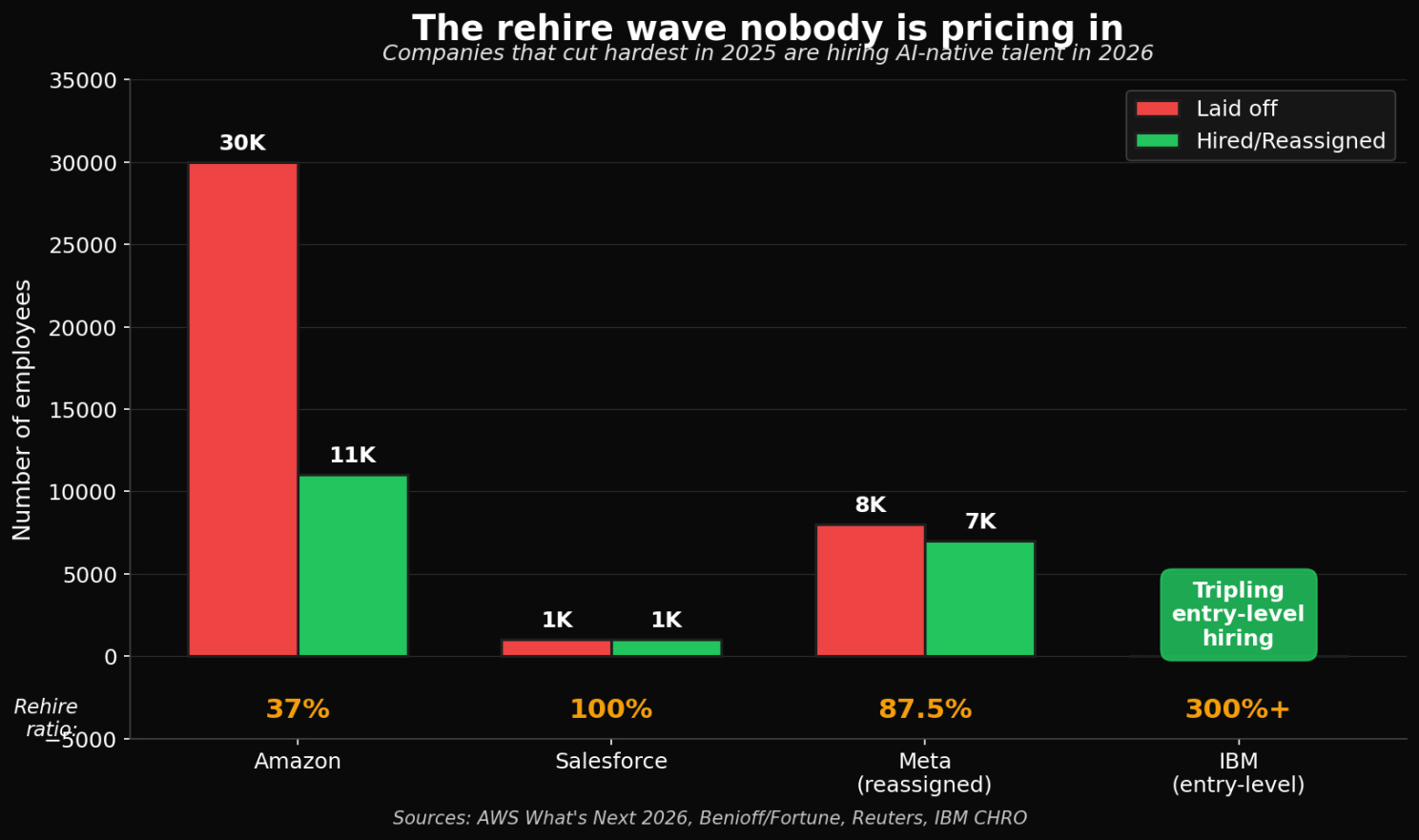
Amazon. AWS CEO Matt Garman announced at the 2026 What’s Next event that Amazon will hire 11,000 software engineers and interns this year, which comes after the company cut 30,000 people in late 2025 and early 2026. The exact words are worth reading in full because the framing matters: “We are hiring just as many software developers as we ever had inside of Amazon. And in fact, I see the demand for that really accelerating. I think as we think about where AI really takes off and where agents can help free us from the monotony of the repeatable parts of our task, it’s really about leaning in.” That’s a 37% rehire ratio at the same company, just for a different skill profile.
Salesforce. Marc Benioff announced on X on April 25, “We’re hiring 1,000 new grads & interns right now to ride the AI exponential,” and the timing is significant because it came months after laying off roughly 1,000 in February 2026 and another 1,000 in February 2025. Salesforce’s Agentforce ARR hit $800 million on the back of this hiring push, up 169% year over year, with 29,000 deals closed since launch. Full replacement ratio, different roles, and they’re now building the AI products that are doing the replacement at other companies.
IBM. Tripling entry-level hiring as of February 2026, with CHRO Nickle LaMoreaux explicitly making the contrarian argument: “The companies three to five years from now that are going to be the most successful are those companies that doubled down on entry-level hiring in this environment.” This is the strongest contrarian signal in the entire essay because the HR head of a Fortune 50 company is explicitly arguing the opposite of the AI replacement narrative that the rest of the industry has been selling.
Meta. Cut 8,000 people, but is reassigning roughly 7,000 of them into newly formed AI-focused teams, which works out to an 87.5% internal reassignment ratio. Zuckerberg explicitly told staff that AI was not driving the layoffs, and the cuts went to areas of the business that were over-resourced while the AI teams kept growing.
The macro signal. The National Association of Colleges and Employers projects employers will increase hiring by 5.6% for the class of 2026, and many of the industries assumed most vulnerable to AI automation (information services, engineering, professional services) are exactly the ones planning to boost hiring most aggressively.
The pattern is clear once you stop reading press releases and start counting jobs. Roughly half the AI-attributed cuts will be reversed by 2027 per Gartner, and the specific company examples sit in a wide range from Amazon at 37% to Salesforce at full replacement, plus significant internal reassignment at companies like Meta. But the new roles are AI-native, and per Forrester, they pay less unless you can prove agent-native productivity. The old roles are not coming back at the old wages.
What the new playbook actually looks like
ClickUp CEO Zeb Evans published a post today, May 22, that reads like the operating manual for the new equilibrium. He cut 22% of the headcount. Then he said the quiet part out loud about what the remaining workforce will look like.
The framing is what he calls the “100x org.” Quote: “The 100x org is actually heavily dependent on people - infinitely more than today. This is only possible with 10x people who have embraced and adopted new ways of working.”
He coined a phrase I want to steal: “the great reckoning of AI coding.” His take is that companies pushing every engineer to use infinite tokens are “celebrating 500% more pull requests” while “customer outcomes don’t match the volume of code being generated.” More code is just another bottleneck. The skill is judgment, not output.
But here is the line that should reset every compensation conversation in tech: “We’re introducing $1 million cash/year salary bands with a path available to nearly everyone in the company if they produce 100x impact by creating or managing AI systems.”
A million dollars cash for AI-native operators. Severance for everyone else.
This is the labor market bifurcation happening in real time, with a number attached. The Writer survey predicted it. ClickUp just put it in writing.
Worth being honest about the tension. ClickUp ALSO cut 22%. Some readers will see this as just another AI layoff dressed up nicely. The honest read is that both things are true. The dying playbook (cut and hope the stock pumps) and the emerging playbook (cut hard, pay survivors like founders) look identical from the outside if you only count the layoffs. The difference shows up in what happens to the people who stay.
If your company is doing the first version, the cuts continue, and morale collapses. If it’s doing the second, the top decile gets a path to seven figures, and the middle has to choose which side of the line they want to be on.
Evans wrote one more line worth holding onto: “Nearly every company will make changes like these. The ones that do it proactively will define what comes next.”
He’s right. And the workers who become AI-native proactively will get the seven-figure bands. Everyone else is competing for what’s left.
The upskilling window
The job market reversal won’t restore the old jobs at the old wages. It creates new ones at slightly lower volume, with sharply bifurcated comp bands, and the window to become AI-native and survive the reset is roughly 18 months. After that, the cohort closes and the new equilibrium sets in for the next decade.
The Writer survey makes the labor market split brutally clear across every dimension. 92% of the C-suite is actively cultivating “AI elite” employees as a deliberate retention strategy. 60% of companies plan layoffs specifically for non-adopters, 77% of executives say employees who refuse to become AI-proficient won’t be considered for promotions, and 90% say AI super-users will require completely rethinking performance evaluation frameworks.
Forrester’s 2026 future of work outlook found that only 16% of workers had a high “AIQ” (their measure of AI readiness) in 2025, projected to reach just 25% by the end of 2026. Which means the other 75% is the addressable market for the rehire wave that’s about to start. Get into the top quartile, and you get the new roles at the new comp bands; stay in the bottom three quarters, and you compete against a much larger labor pool for what’s left.
The productivity gap between cohorts is already showing up in the data. AI super-users save 9 hours per week compared to laggards, which is 4.5x the productivity differential. They are 3x more likely to have received both a promotion and a raise in the past year. This is the gap that’s about to widen into a chasm as the rehire wave selects on these exact attributes.
So what does AI-native actually mean in 2026, as a practical matter? Prompt engineering is table stakes at this point, not a differentiator. The real skill is agent orchestration, which covers knowing how to design multi-agent workflows with proper handoffs, building eval suites that actually catch failure modes, architecting RAG systems over private data, and managing token budgets at the workflow level. It also covers knowing when to use Frontier Intelligence versus when Flash-Lite will do the job for a fraction of the cost. And the most underrated skill of all: knowing when not to use AI in the first place, because forcing it into the wrong workflows is how the 71% of failed implementations got there.
The companies hiring right now are hiring exactly this profile. Amazon’s job descriptions explicitly require “experience with AI tools for development productivity.” Salesforce’s new grad program is building Agentforce. The training programs at IBM and AWS are heavily agent-orchestration focused. If you can ship an agentic workflow today, you’re in the rehire cohort. If you can only use ChatGPT to write emails, you’re not.
The new equilibrium
The layoff trade is dead, the rehire trade is on, but it’s only on for one specific kind of worker. The next 18 months is a one-time window, and the cohort that becomes AI-native between now and the end of 2027 will own the new equilibrium of knowledge work for the next decade. Everyone else competes for a smaller pool of jobs that weren’t automated, at lower wages, against a much bigger labor pool that’s also been displaced.
The companies that figured this out are already hiring. Amazon, Salesforce, IBM, and ClickUp are running the new playbook openly while most of the industry is still running the dying one. The companies still trying to pump their stock with AI-flavored layoffs are about to learn what GitLab and Meta just learned, which is that Wall Street stopped buying the narrative sometime in Q2 2026 and isn’t coming back.
So where do you sit on the line?
I built ismyjobscrewed.com to answer exactly that question. Score your role against actual displacement data, see your risk percentage, and get a tailored upskilling path so you’re in the AI-native cohort when the rehire wave hits your industry. Takes 90 seconds, costs nothing, and might save your career trajectory in the bifurcation that’s already underway.
A note on certainty. This is forecasting, not prophecy. The future surprises everyone, and macro, algorithmic, or geopolitical shocks could change the timing of all of this. But too many independent data points across token economics, ROI surveys, capex warnings, public CEO statements, and hiring reversals are triangulating in the same direction for the structural pattern to be wrong.
References: https://telegra.ph/Tech-Hiring-Is-Coming-Back-But-Most-Wont-Make-The-Cut-References-05-23